
There was an amusing thread on intfiction.org a few years back titled “That darn cat keeps opening doors!” The OP was working on an Inform 7 game, and had created a cat who they wanted to wander randomly from room to room. But rather than going only through open doors like a real cat would, this cat was also opening closed doors in order to pass between rooms.
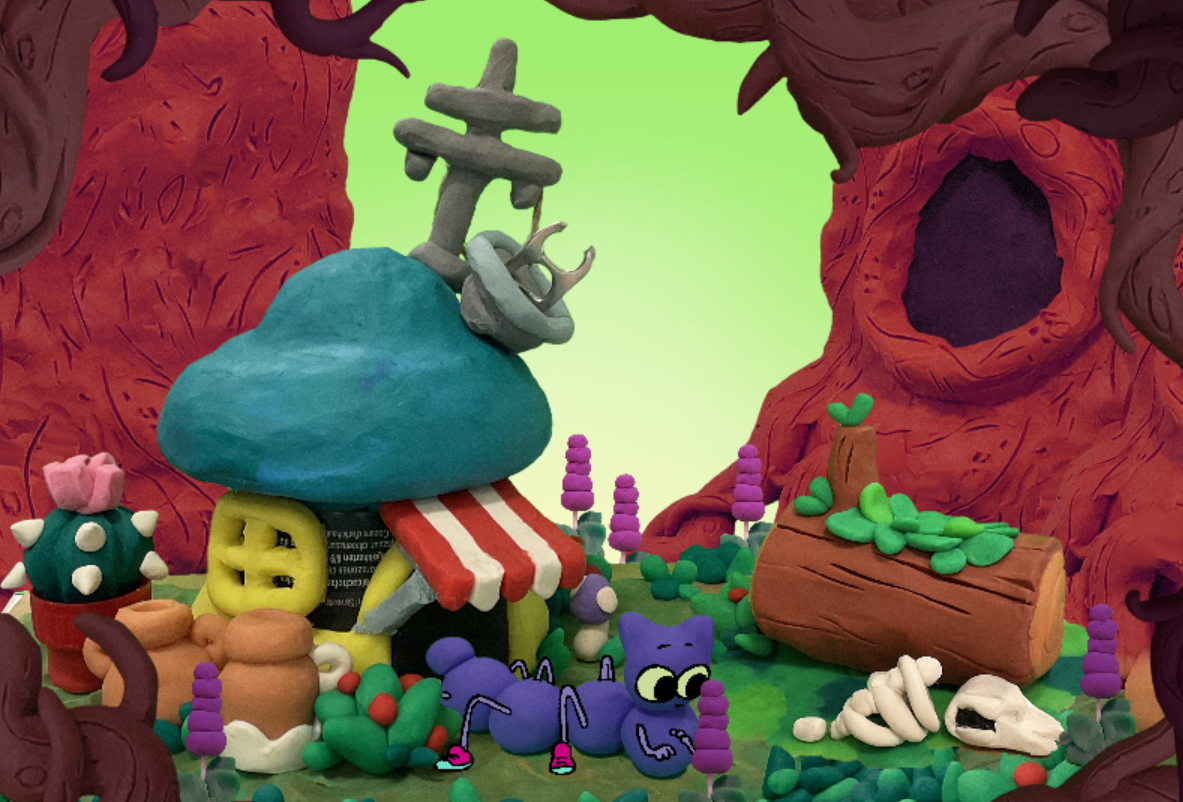
The phrase “diorama games” was mentioned in passing on the game poems discord. I absolutely love this idea, and would consider a game that consisted only of a cat wandering freely around a map–through open and closed doors, and perhaps also windows–to be a diorama game. After some cursory searching, however, I didn’t get the sense that “diorama game” was as widely recognized a concept as, say, “walking sim” or “sandbox game.” So, in the apparent absence of a generally accepted definition, I had a go at identifying some key characteristics of what might be considered a diorama game:
- No narrative beginning or end: This suggests that diorama games exist in a kind of suspended time
- No fail or win/completion state
- A contained environment: The boundaries of the game world are obvious
- Limited or no player agency: The player’s passivity paradoxically makes the game itself feel more alive (I consider setting initial parameters to be pretty significant player agency)
To test and refine this criteria, I compiled this haphazard and non-exhaustive list of games that have diorama elements:
| Game | No narrative beginning/end | No fail/win state | Contained environment | Low/no player agency |
| Cat wandering around a map: the game | X | X | X | X |
| Plasti Terrarium by nbmach1ne | X | X | X | X |
| Desktop pets | X | X | X | X |
| Lofi girl, et al. | X | X | X | X |
| Caelyn Sandel’s Tiny Utopias | X | X | X | |
| Mossland by adam le doux | X | X | X | |
| Ryan Veeder’s Authentic Fly Fishing | X | X | X | |
| Sandbox games | X | X | ||
| Simulation mode in A Mind Forever Voyaging | X | X | ||
| The Fire Tower by Jacqueline A. Lott | X | X | ||
| Farming sims | X | X | ||
| The Sims | X | |||
| Tamagotchis | X* | |||
| Progress Quest | X | |||
| Conway’s Game of Life | X |
*I went back and forth about this. I remember the first tamagotchis existing in a kind of infinite non-space, but it appears that the current generation of tamagotchis live in contained environments like rooms and courtyards and gardens.
So what makes diorama games so appealing?
The bounded worlds of diorama games suggest domination, thereby imparting to the player a aura of grandiosity. This is a hallmark of miniatures, according to Gaston Bachelard: “The cleverer I am at miniaturizing the world, the better I possess it.”1 Bachelard also describes miniatures as evoking newness, immensity, and the fantastical visions of childhood. Images of miniatures, which possess a “metaphysical freshness,”2 are thresholds into daydreams: “Thus the minuscule, a narrow gate, opens up an entire world.”3

Diorama games feature little to no player agency; they operate mostly autonomously. Another potential reference point, then, might be automata. Automata, according to Ernst Jentsch, produce uncanny effects for as long as there is uncertainty as to whether or not they are truly alive. Mark Fisher echoes this sentiment in his conception of the eerie: “The eerie concerns the unknown. When knowledge is achieved, the eerie disappears.”4 He further discusses the eerie in terms of agency: eerie absences and presences hint at invisible forces, like capitalism, that govern our lives. Perhaps this partially accounts for the appeal of diorama games: Without significant player interaction, diorama games appear to function on their own and feel “alive.” This, in turn, produces uncanny and eerie effects, which we experience as thrilling or pleasurable.
Iʻve been poking at the edges of diorama games with my Neo-Twiny Jam games Scale (an “open-world” aquarium in 447 words) and Weather Room: a Wind-up Toy. This exercise has helped me to clarify my thinking, so that I can make even more diorama games. Maybe it will inspire someone else to make this kind of diorama game too!
UPDATE: I created an itch collection called Diorama games and tiny worlds to gather games like these. Note that not all of them check all of the boxes in the matrix above.
 La Vie en Meow
You must be logged in to post a comment.